
Tech Insights
Robotics & Physical AI: The Next Investment Opportunity Redefining the Physical World
May 11, 2026
[Executive Summary]
1. Key Technology Trends and Market Outlook
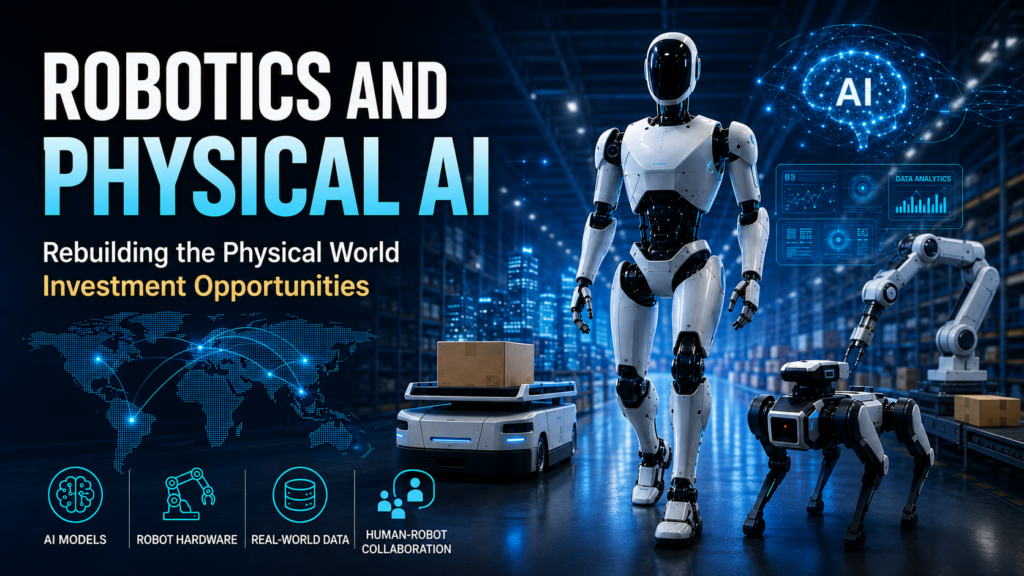
- Technology Definition: Physical AI refers to the evolution of AI models into autonomous agents that can perceive, reason, and act within physical environments through integration with sensors and robotic hardware.
- Four Major Technology Trends:
① Accelerating commercialization of humanoid robots
② Evolution toward Agentic AI (action-oriented AI)
③ Vertical integration of hardware and software
④ Expansion of human-robot collaboration - Market Size: The global robotics market is projected to reach USD 111 billion by 2030. In particular, the humanoid robotics market is expected to grow at a CAGR of 39.2%. The period from 2026 to 2030 is expected to be a critical phase where pilot projects transition into large-scale commercial deployment. (Source: ABI Research, MarketsandMarkets)
2. Value Chain and Revenue Structure
- Four-Stage Value Chain:
① Upstream: AI semiconductors, robot foundation models, simulation platforms (e.g., NVIDIA, Google)
② Midstream: Core components such as reducers, motors, sensors, and actuators
③ Downstream: Robot manufacturers (e.g., Tesla, Figure AI, Boston Dynamics)
④ Applications: Service layers in manufacturing, logistics, healthcare, and other industries - Monetization Trends: Beyond simple hardware sales, long-term revenue growth is expected to come from Robot-as-a-Service (RaaS), maintenance services, and continuous model improvements driven by real-world operational data.
3. Major Domestic and Global Players
- Global Leaders:
NVIDIA and Google DeepMind are leading in AI infrastructure and intelligence platforms, while Tesla, Boston Dynamics, Figure AI, and 1X Technologies are leading in humanoid robot development. - Korean Companies:
Backed by one of the world’s highest robot adoption rates, Korean companies such as Hyundai Motor Company (through its ownership of Boston Dynamics), Samsung Electronics (in collaboration with Rainbow Robotics), Doosan Robotics, and LG Electronics are expanding their capabilities in robotics manufacturing and mass production.
4. Investment Implications and Risks
- Promising Investment Areas:
① Robot foundation models
② Core components (reducers, sensors, etc.)
③ Industrial application robots
④ RaaS (Robot-as-a-Service) platforms - Key Investment Criteria:
Investors should focus not merely on technological sophistication or robot appearance, but on companies with scalable deployment potential, clear customer ROI, and strong data network effects. - Key Risks:
Major commercialization challenges include achieving economic viability, safety regulations, battery efficiency, supply chain stability for critical components, and the ability to secure high-quality real-world operational data.